
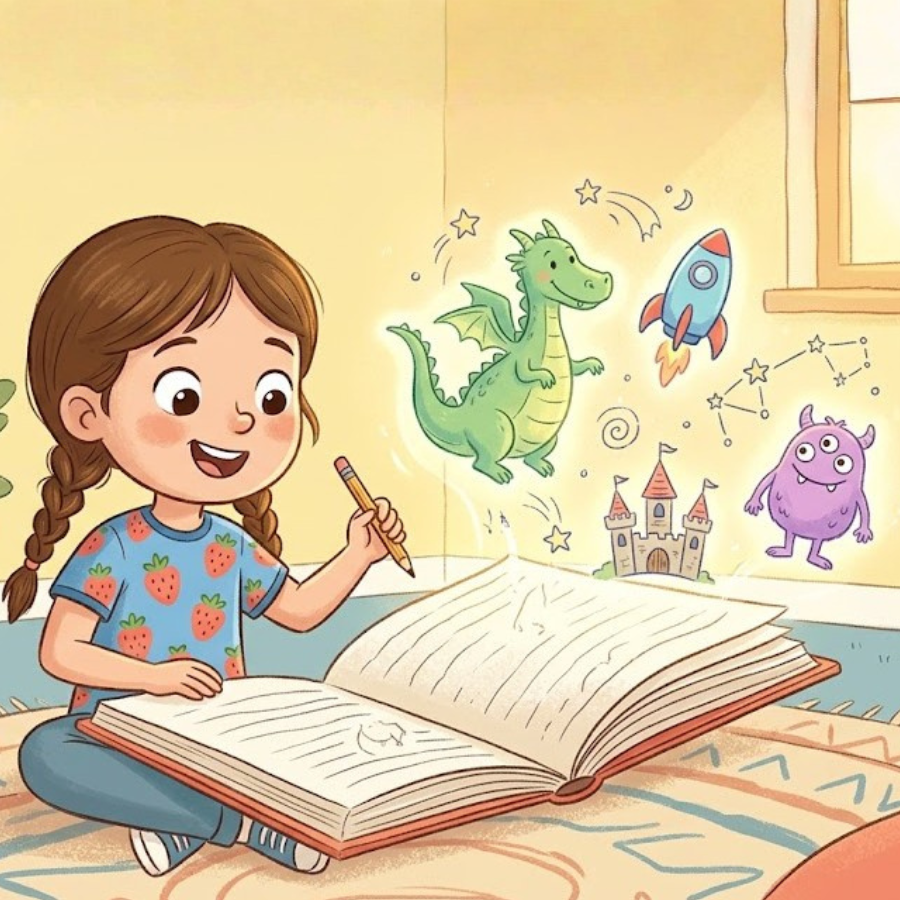
Writing a mystery is hard. Writing one for a reader who’s never read a mystery, and handing the whole thing to a six-year-old narrator, turns out to be a different sport entirely.
That’s the job The Boll Weevil Bandit handed me. Maisie Jo is in the first grade, and she has decided that she’s going to be a detective. It’s the first book in a new series for brand-new readers, and writing it taught me a lot about voice.
Here’s what I learned trying to put a real mystery in the hands of someone who’s barely reading on her own.
A seven-year-old narrator can’t know more than a seven-year-old
When I write for adults, I can lean on a narrator who quietly understands more than the characters do. Maisie can’t. She only knows what she notices, and what she notices is gloriously, specifically seven: who got to paint the best part of the class project, whose car has a name, which classmate is making a mad face at her right this second.
So the craft problem becomes: how do you let the reader catch a clue the narrator walks right past? You hand it to them through Maisie without Maisie realizing she’s handing it over. She reports the world honestly; the reader gets to be the one who goes, “wait — back up.” That gap, between what Maisie sees and what it means, is the whole engine of the book. (And really, this is what makes any good mystery, even with an adult sleuth.)

You can’t cheat a new reader. They’ll catch you.
There’s a temptation, writing for little ones, to wave your hands at the logic. Don’t. Newer readers are some of the most rigorous readers you will ever meet. If the answer comes from nowhere, a seven-year-old will look up from the page and tell you so, and they will be right.
So I won’t tell you who the Boll Weevil Bandit turns out to be (that would be deeply against the rules, and Maisie would never forgive me). But I’ll tell you the book plays fair, everything you need is on the page before the answer arrives, and that a kid who reads carefully has a real shot at solving it before Maisie does.
Voice is a discipline, not a costume
The easiest way to write a child narrator badly is to make her cute. Cute is a costume. The harder, truer thing is to take her completely seriously, to let her panic about things that genuinely matter to her, hold a grudge over the snout of a papier-mâché bug, and announce her opinions as scientific fact. I gave her one best friend who notices what she misses, one rival who’s better at making faces than alibis, and a notebook with a magnifying glass on the cover that is, at the start, almost entirely empty.
Because nothing in her life has ever been very mysterious.
Yet.
Coming soon
The Boll Weevil Bandit is on its way. If you write for children, I hope the voice notes above are useful at your own desk. And if you’ve just got a small reader who notices everything and isn’t above a bit of dramatic panicking, I wrote it for them, but I think I’m the one who learned the most.