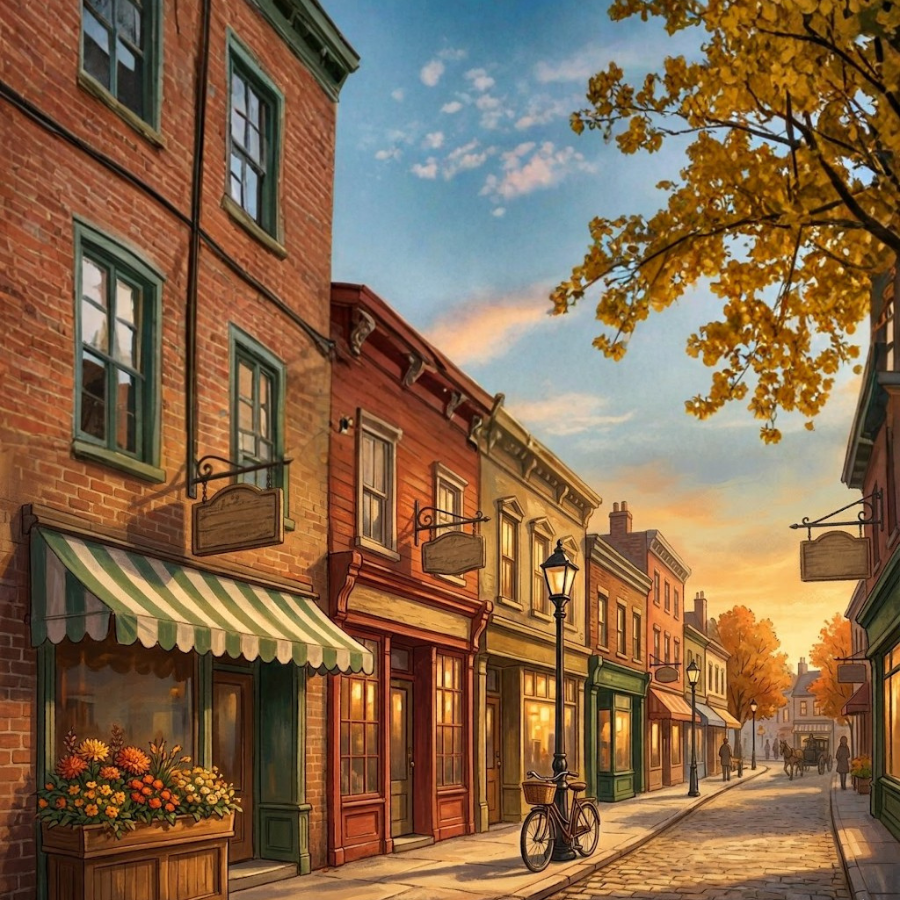

There’s a particular kind of silence that only exists in a small town. It isn’t the empty hush of the desert or the lonely quiet of a city apartment at three in the morning. It’s heavier than that. Expectant. It’s the quiet of a hundred eyes watching from behind lace curtains, and a hundred ears pressed politely against the thin wall of neighborly privacy.
I think that silence is the actual heartbeat of a cozy mystery. It’s not the murder, not the sleuth, not even the cup of coffee growing cold on the kitchen table. It’s the silence. The held breath of a town once they know something is wrong, but are unsure of who to blame within their close-knit ranks.
And the cozy mystery math seems to keep working out the same way: the smaller the town, the bigger the secrets.
The Charm (and the Trap) of a Tight-Knit Town
In a city, you can be anyone. You can change your name on a Tuesday and have a brand new life by Friday. Nobody’s keeping score. Nobody’s even watching.
But a small town? Your history is written on the walls of the local diner. People don’t just know your name. They know your grandmother’s maiden name, which pew you sit in on Sunday morning, whether you take your coffee black or doctored, and exactly how your granddaddy lost the back forty in ’47. They remember things about you that you yourself have worked very hard to forget.
That’s what makes the cozy mystery genre so impossibly addictive. There is a real, physical comfort in a place where everyone knows everyone. It’s nostalgic. It feels like home. It feels safe.
But for a mystery writer, that safety is a beautiful, terrible trap.
When everyone knows everyone, a crime stops being just a legal problem and becomes something far more troublesome — a personal betrayal. The killer isn’t a faceless stranger in a dark alley. The killer is the man who sold your mama her car insurance last spring. Or the woman who took the blue ribbon for her peanut butter cake at the Peanut Festival three years running.
That’s where the tension lives. Not in the violence, but in the polite, pleasant look on a neighbor’s face. You know the one that might just turn out to belong to the killer.
Grounding the Story in a Real Sense of Place
To make a fictional town feel real on the page, you have to ground it in landmarks that carry actual weight.
For me, in my current cozy mystery, the inspiration is just down the street.
We may not have a lot of things in my hometown, but what we have is unique. The Boll Weevil Monument sits right in the middle of Main Street, and traffic just has to figure her out. Our High School marching band practices how to split and flow around the Boll Weevil Monument almost more than they practice making right turns in one cohesive group.
When you put a landmark like that into a piece of fiction, it does so much more than set the scene. It gives the story a pulse. The reader can feel how the town moves around its own history and how everyone who lives in the small town has something in common.
That’s exactly what I’ve been chasing in my current series, Wiregrass Roots. Although it’s fiction, I wanted to anchor it to a real place. Somewhere readers from the area will instantly feel a bond with. And somewhere readers who’ve never heard of the Wiregrass will be intrigued and want to come see for themselves.
In the first book, Kin, Lies, and Alibis, my ameteur sleuth Maggie Kate is sitting at her desk turning over what might be a clue and in the middle of that small, ordinary moment of thinking, the landmark drifts into her view. That, to me, is the best way to do world-building. You don’t stop the story to point at the scenery for 3 pages. Instead, you weave it in at exactly the moment it belongs, like in this excerpt:

She tore a Post-it from the pad. Brooch? Research. The pen pressed harder than she meant it to on the question mark. She pressed the note to the front of the Whatley file, smoothed it twice, and reached for the magnifying glass anyway.
Out the front window, a man with a military buzz-cut had his phone aimed up at the weevil, walking a slow half-circle around the base. His wife laughed at something and pointed. Maggie Kate watched them a moment longer than she needed to. An absent-minded smile drifted across her face.
The radio in the back room was playing the farm report. Soybeans were down. Peanuts were holding.
She shook her head, remembering the task, and looked back at the file.
Why We Keep Coming Back
I think we read cozy mysteries because, deep down, we want to believe that justice can still be found in a chaotic world. We want to watch the amateur sleuth quietly set things to rights again.
But honestly? That’s only half the reason.
The other half is that we want to go somewhere. We want to visit a town where the coffee’s always hot, the diner waitress remembers your order, the secrets are juicy enough to chew on, and the red clay tells you a story if you’ll just slow down long enough to listen.
As I keep mapping out the master arc for the Wiregrass Roots series, I’m reminded of this all over again: the setting isn’t just where the story happens. The setting is the story. The land, the landmarks, the local legends.
Want to know the minute Kin, Lies, and Alibis is ready for your bookshelf? Sign up for my newsletter for sneak peeks and the occasional behind-the-scenes look at a manuscript-in-progress.
Author’s note: Writing this post reminded me how much I love the show-don’t-tell side of world-building. It’s rarely the grand pronouncement that does the work. It’s the hum of a dryer, the stain on a thumb, the way someone won’t quite meet your eye in the produce aisle at Piggly Wiggly. So tell me. What’s the unique part of your hometown? Drop it in the comments. I’m nosy.